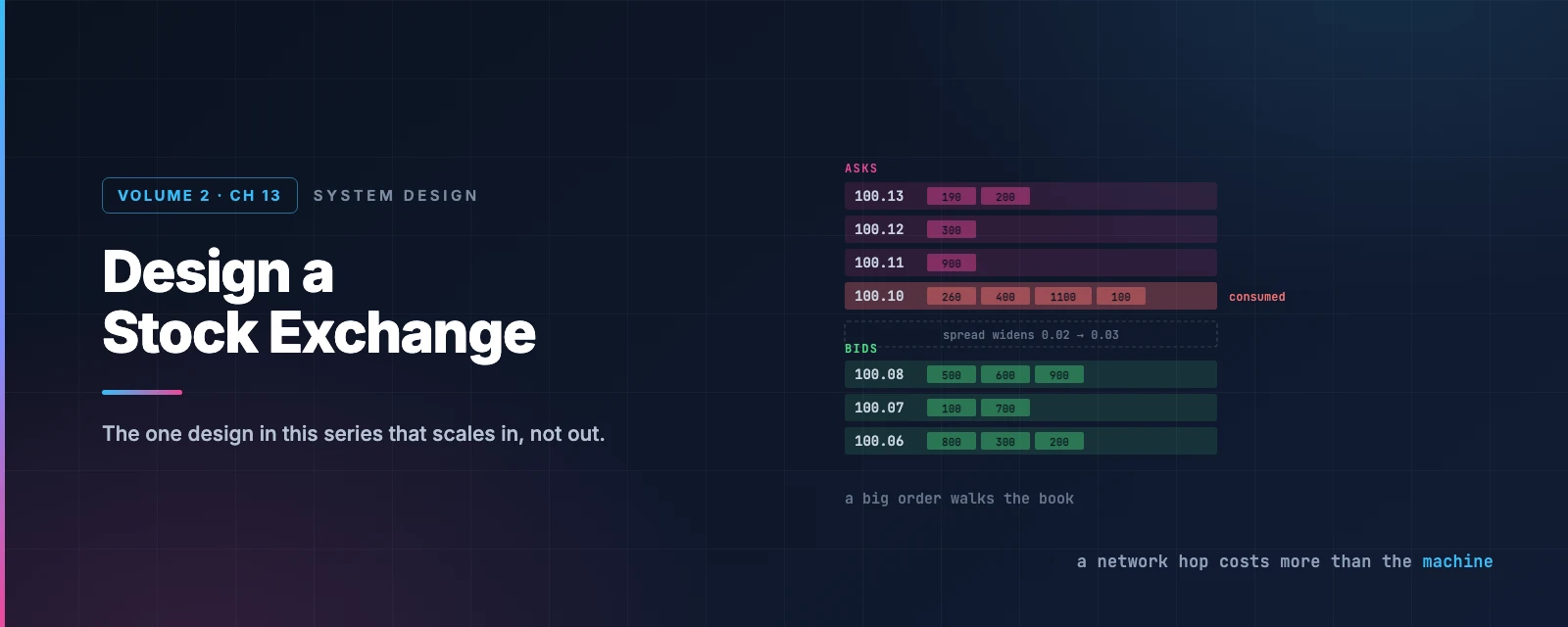
Design a Stock Exchange
Every design in this series so far has scaled out. More partitions, more replicas, more nodes.
This one scales in.
The fastest exchanges in the world run almost everything — order manager, matching engine, market data publisher — on a single server, sometimes in a single process. Not because they can’t afford more machines, but because the network hop between two machines costs more than the machine does.
That inversion is what makes this chapter worth reading. Everything you’ve been taught about distributing work stops applying when a round trip costs more than your entire latency budget.
Step 1 — Scope
Functionality: place a limit order, cancel an order, view real-time executions and the order book. Risk checks. Wallet balance verification with funds withheld on open orders.
Scale: 100 symbols, tens of thousands of concurrent users, a billion orders per day.
1,000,000,000 orders ÷ (6.5 hours × 3,600) ≈ 43,000 QPS
Peak (5×)                                  ≈ 215,000 QPS
Note the 6.5 hours — markets open at 9:30 and close at 16:00. Volume is heavily concentrated at both ends.
Non-functional, and this is where it gets unusual:
- 99.99% availability — 8.64 seconds of downtime per day
- Millisecond round-trip latency, measured at the 99th percentile
A persistently high 99th percentile causes a terrible experience for a small number of users — and in trading, those users are the ones who notice.
Average latency is nearly meaningless here. A system averaging 200 microseconds with occasional 50-millisecond stalls is unusable, because the stalls land on real trades and someone loses real money. Consistency of latency matters more than its magnitude.
Market data 101
Four pieces of vocabulary, because the rest of the design assumes them.
A broker sits between you and the exchange. Robinhood, Fidelity, Interactive Brokers. You never talk to the exchange directly; the broker holds the connection, and the exchange sees the broker.
Institutional clients are treated differently, and not as a courtesy. A pension fund buying two million shares cannot send that as one order — it would move the price against itself before filling. So the order is split into small pieces released over time, which is why exchanges expose specialised low-latency interfaces alongside the retail path.
Two order types. A limit order names a price: buy at 100.10 or better. It may not match at all, and it may match partially. A market order names no price and executes immediately at whatever the book offers. This design supports limit orders — market orders are the easy case once limit orders work.
Bid and ask. The bid is the highest price any buyer will pay. The ask (or offer) is the lowest price any seller will accept. The gap between them is the spread, and it is the exchange’s most-watched number.
The three tiers of price quotes
US markets sell market data at three levels of detail, and the difference is exactly how much of the order book you are allowed to see:
| Tier | What you get | Who uses it |
|---|---|---|
| L1 | Best bid and best ask, with the quantity available at each | Retail apps, price tickers |
| L2 | Several price levels deep on both sides | Active traders reading supply and demand |
| L3 | Every price level and the queued orders at each level | Market makers, the exchange itself |
The tiers are not just a pricing gimmick. L3 tells you your position in the queue at a price level, which under FIFO matching determines whether you get filled at all. That information is worth money, which is why it costs money.
Candlesticks
The other way market data is consumed is aggregated into intervals. A candlestick summarises one interval with four prices — open, close, high, low — plus the volume traded:
flowchart LR
    T["Every execution
in the interval"] --> A["Aggregate"]
    A --> O["open — first price"]
    A --> C["close — last price"]
    A --> H["high — max price"]
    A --> L["low — min price"]
    A --> V["volume — total quantity"]

    style A fill:#fef3c7,stroke:#d97706,color:#78350f
One candlestick per minute, per hour, per day — the resolution is a query parameter. This is what every price chart you have ever seen is made of.
FIX
FIX (Financial Information eXchange) is the protocol the industry actually speaks. It is a plain-text, tag-value format that has been in production since 1992:
8=FIX.4.2 | 9=176 | 35=8 | 49=PHLX | 56=PERS | 52=20071123-05:30:00.000 |
11=ATOMNOCCC9990900 | 150=E | 39=E | 55=MSFT | 54=1 | 38=15 | 40=2 | 44=15 | 10=128 |
Each number is a field tag: 55 is the symbol, 54 is the side, 38 the quantity, 44 the price. It is not elegant, and it is not going anywhere — when a design decision in this chapter looks strange, FIX compatibility is often the reason.
The order book
Everything in an exchange revolves around one data structure.
An order book is the list of resting buy and sell orders for a symbol, organised by price level — the bid and ask from the previous section, expanded into every level behind them.
The requirements are demanding:
- O(1) placing, cancelling, matching
- Constant-time lookup of volume at a price level
- Query best bid/ask instantly
- Iterate price levels in order
Watch it match
A market buy consumes the ask side from the best price upward. Drag the quantity and watch it walk the book:
Push it to 2,700. The entire 100.10 level is consumed, then most of 100.11 — and the best ask moves up a level while the spread widens from $0.02 to $0.03.
That’s price impact, visible directly. A large order doesn’t execute at one price; it walks the book, paying progressively worse prices. Which is why institutional clients need order splitting: submitting the whole thing at once moves the market against you.
Getting to O(1)
The natural implementation:
class PriceLevel {
    Price limitPrice;
    long totalVolume;
    List<Order> orders;      // ← the problem
}
class OrderBook {
    Book<Buy> buyBook;
    Book<Sell> sellBook;
    PriceLevel bestBid, bestOffer;
    Map<OrderID, Order> orderMap;
}
A plain list makes cancellation O(n) — you’d traverse to find the order’s predecessor.
Two changes fix it:
Make orders a doubly-linked list. Placing appends to the tail: O(1). Matching removes from the head: O(1).
Keep Map<OrderID, Order>. Cancellation looks the order up in O(1), and because the list is doubly-linked, the order already knows its predecessor — unlink without traversing.
All three operations become O(1), and the second one is the interesting trick: a hash map alongside a linked list, each covering the other’s weakness. Exactly the pairing behind Redis sorted sets, for the same reason.
FIFO, and the alternatives
Making the operations O(1) settles how fast you match. It does not settle who you match — and at a busy price level with more resting orders than incoming quantity, something has to choose.
The loop itself is unremarkable:
Context match(OrderBook book, Order order) {
    Quantity leaves = order.quantity - order.matchedQuantity;
    Iterator<Order> it = book.limitMap.get(order.price).orders;
    while (it.hasNext() && leaves > 0) {
        Quantity matched = min(it.next.quantity, order.quantity);
        order.matchedQuantity += matched;
        leaves = order.quantity - order.matchedQuantity;
        remove(it.next);
        generateMatchedFill();
    }
    return SUCCESS(MATCH_SUCCESS, order);
}
The allocation policy is hiding in the iteration order. Walking the doubly-linked list from the head means the oldest order at that price fills first — FIFO, also called price-time priority. It is the default across equity markets, and it is what makes L3 data valuable: your place in that list is your probability of getting filled.
It is not the only option:
| Policy | Fills go to | Used where |
|---|---|---|
| FIFO / price-time | Oldest order at the price level | Most equity markets |
| Pro-rata | Split across all orders at the price, proportional to size | Some futures and options markets |
| Hybrid | A slice to the first order, the rest pro-rata | Several derivatives venues |
The choice has real consequences for behaviour. FIFO rewards being early, so it pushes participants to race on latency — which is a large part of why this chapter is about microseconds at all. Pro-rata rewards being large, so participants inflate order size instead. Neither is neutral; an exchange picks the incentive it prefers.
The handler around the match loop also does two things worth noting: it rejects out-of-order sequence IDs outright, and it fails a cancel for an order that has already matched. Both fall out of the sequencer design in the next section.
Step 2 — High-level design
Three flows with very different requirements.
flowchart TD
    C["Client"] --> B["Broker"] --> G["Client gateway
auth, validation, rate limit"]
    G --> OM["Order manager
risk checks, wallet"]
    OM --> SQ["Sequencer"]
    SQ --> ME["Matching engine"]
    ME --> SQ2["Sequencer"] --> OM
    ME -.->|"market data flow"| MDP["Market data publisher"]
    MDP -.-> DS["Data service"]
    ME -.->|"reporting flow"| RP["Reporter"] --> DB[("Database")]

    style ME fill:#fce7f3,stroke:#db2777,color:#831843
    style SQ fill:#fef3c7,stroke:#d97706,color:#78350f
    style OM fill:#dbeafe,stroke:#2563eb,color:#1e3a8a
    style MDP fill:#dcfce7,stroke:#16a34a,color:#14532d
The trading flow is the critical path — gateway → order manager → sequencer → matching engine — and it must be microseconds.
Market data and reporting are not. They can lag. Separating them by latency requirement is the first architectural decision, and it’s what lets the critical path stay minimal.
The sequencer
The most important component you wouldn’t think to invent.
It stamps every incoming order with a sequential ID before the matching engine sees it, and stamps every outgoing execution too. Sequential, so gaps are detectable.
That single act buys three things:
Timeliness and fairness — order of arrival is recorded, not inferred.
Deterministic replay — given the same input sequence, the matching engine produces the same output sequence. Always.
Exactly-once — sequence gaps reveal loss.
Determinism is the foundation of everything that follows. High availability, fast recovery, and hot-warm failover all work because replaying the log reproduces the state exactly. Without the sequencer, none of it holds.
Crucially there is exactly one sequencer per event store. Multiple writers would contend for the right to write, and in a system this hot, lock contention is the whole budget. A single writer is faster than a lock.
The API
Clients reach the exchange through their broker, and the broker talks to the client gateway. That link is a plain REST API — the latency budget is spent inside the exchange, not on the retail path. Institutional clients get a proprietary binary protocol instead, for the reasons in the previous section.
Four endpoints cover the chapter:
| Endpoint | Purpose |
|---|---|
POST /v1/order | Place an order — symbol, side, price, orderType, quantity |
GET /execution?symbol=&orderId=&startTime=&endTime= | Query executions in a time range |
GET /marketdata/orderBook/L2?symbol=&depth= | The book, depth levels per side |
GET /marketdata/candles?symbol=&resolution=&startTime=&endTime= | Candlesticks at a given resolution |
Two details in the order response are worth pausing on:
{
  "id": 1287346512,
  "creationTime": 1655380800000,
  "filledQuantity": 300,
  "remainingQuantity": 700,
  "status": "new"
}
filledQuantity and remainingQuantity are separate fields, because partial fills are the normal case, not an edge case. A 1,000-share limit order that finds 300 shares at its price stays live for the rest. And status is one of new / canceled / filled — there is no “pending”, because the sequencer means an order either has a sequence number or does not exist.
Note the market-data endpoints name the tier and resolution explicitly. orderBook/L2 is a product decision in a URL: L1 is cheap, L2 costs more, L3 is sold under contract.
Data models
Three kinds of data move through the system, and each takes a different path:
| Data | Where it lives |
|---|---|
| Product, order, execution | In memory on the critical path; written to the database by the reporter |
| Order book | In memory only, rebuilt from the event stream |
| Candlestick chart | Built in the market data service from executions |
Products describe a tradable symbol — product type, trading symbol, the symbol shown in a UI, lot size. This data barely changes and is mostly used for rendering.
Orders are instructions; executions are what came back out. One order produces zero, one, or many executions, and an execution always points back at its order:
flowchart LR
    P["PRODUCT
symbol, productType, displaySymbol"]
    O["ORDER
id, symbol, side, price,
quantity, filledQuantity, status"]
    E["EXECUTION
id, orderId, symbol,
side, price, quantity"]
    P -->|"traded as"| O
    O -->|"produces 0..n"| E

    style P fill:#dbeafe,stroke:#2563eb,color:#1e3a8a
    style O fill:#fef3c7,stroke:#d97706,color:#78350f
    style E fill:#dcfce7,stroke:#16a34a,color:#14532d
The same order and execution objects appear in all three flows, which is the point: they are processed in memory on the critical path and recovered from the sequencer, written to the database by the reporter, and forwarded to market data to rebuild the book and the candlesticks. One representation, three consumers, three very different latency requirements.
Candlesticks are computed in the market data service from the execution stream:
class Candlestick {
    private long openPrice, closePrice, highPrice, lowPrice;
    private long volume;
    private long timestamp;
    private int  interval;
}
class CandlestickChart {
    private LinkedList<Candlestick> sticks;
}
Two memory optimisations matter once you keep years of these in a hot path. Hold the sticks in a pre-allocated ring buffer rather than allocating each one — the same allocation-free discipline the deep dive is about. And cap how many stay in memory, persisting the rest. Real-time analytics runs on an in-memory columnar database such as kdb+; after market close the data moves to a historical store.
Step 3 — Deep dive: making it fast
Latency decomposes simply:
latency = Σ execution time along the critical path
Two levers: fewer tasks on the path, and less time per task. The exchange pulls both, hard — even logging is removed from the critical path.
Why one server
Components on separate machines communicate over the network. A round trip is roughly 500 microseconds. Several hops on the critical path and you’re into single-digit milliseconds before doing any work. Add disk-backed event persistence and you’re at tens of milliseconds.
Respectable in 2005. Uncompetitive now.
So the design collapses: put every critical-path component on one server.
flowchart LR
    subgraph S["A single server"]
        direction LR
        OM["Order manager
application loop"] --- MM{{"mmap event store
/dev/shm"}}
        ME["Matching engine
application loop"] --- MM
        MD["Market data publisher
application loop"] --- MM
    end

    style S fill:#dbeafe,stroke:#2563eb,color:#1e3a8a
    style MM fill:#fce7f3,stroke:#db2777,color:#831843
mmap over /dev/shm is the mechanism. /dev/shm is a memory-backed filesystem, so mapping a file there gives shared memory between processes with no disk access at all. A message on this bus takes sub-microsecond.
The result is microservices — separate processes, clean boundaries, independent deployment — communicating a thousand times faster than a network call. You keep the architectural benefits and delete the transport cost.
Application loops and CPU pinning
Each component runs an application loop: a single thread in a while loop, polling for work, pinned to a fixed CPU core.
Two benefits, both aimed at the tail:
No context switches. The core belongs to that loop.
No locks, therefore no lock contention — only one thread mutates the state.
The cost is real: every task must be analysed for how long it occupies the loop, because a slow task blocks everything behind it. You are hand-managing the scheduler, which is only worth it when a scheduler decision costing 50 microseconds is a bug.
Event sourcing again
The event store is an immutable log of state-changing events, and the same design as the digital wallet — but here the motivation is speed and recovery rather than audit.
Two changes make it fit an exchange.
The order manager becomes a library, embedded in several components rather than a service they call. Order state is needed by the matching engine, the reporter and the market data publisher; making them call a shared service would put network hops back on the path. Instead each embeds the library and derives identical state from identical events — guaranteed by determinism.
The sequencer shrinks. No longer a message store, just a single writer stamping sequence IDs — pulling from each component’s local ring buffer and writing to the event store.
Hot-warm failover
flowchart LR
    E{{"Event store"}} --> H["Matching engine
HOT — processes and emits"]
    E --> W["Matching engine
WARM — processes, emits nothing"]
    H -->|"heartbeat"| M["Monitor"]
    M -.->|"heartbeat missed → promote"| W

    style H fill:#dcfce7,stroke:#16a34a,color:#14532d
    style W fill:#fef3c7,stroke:#d97706,color:#78350f
The warm instance consumes the same events and computes the same state — it simply doesn’t emit. On failure it takes over immediately, already warm, no state transfer.
This works only because of determinism. Same events in, same state out, guaranteed.
Beyond one server, Raft replicates the event store across machines and elects a leader — with a Raft cluster of 5, you tolerate 2 failures.
And two honest cautions about failover that most designs skip:
False alarms cause unnecessary failovers, which are themselves risky.
A bug that killed the primary will kill the backup too. Failover protects against hardware and environment, not logic. So: manual failover at first, automating only once you have operational confidence — with chaos engineering to build it faster.
Latency determinism
Two kinds of determinism matter, and only one gets discussed.
Functional determinism — same events, same results. Handled by the sequencer.
Latency determinism — nearly the same latency every time. Measured at p99, or p99.99.
The classic culprit in a JVM exchange is stop-the-world garbage collection. Everything is fast, then a collection pauses the world for milliseconds, and those milliseconds land on somebody’s trade.
A system with a great average and a bad tail is a bad system here. Which is why exchange engineers obsess over allocation-free code paths, pre-allocated ring buffers, and cache-line padding — all techniques for eliminating variance, not just cost.
Fairness as an engineering requirement
Here is something no other design in this series has: fairness is a regulated obligation, and it shows up in implementation details.
Subscriber ordering. If the market data publisher holds a list of subscribers and sends in list order, whoever connects first gets data first — and therefore gets to trade on it first. So clients race to connect at market open. The fixes: multicast, so everyone receives simultaneously, or randomised subscriber order.
Multicast uses UDP, which is unreliable, so retransmission schemes like NACK-oriented reliable multicast are needed.
Colocation. Exchanges rent rack space in their own data centre. Latency then becomes proportional to cable length. That sounds like the opposite of fair, and it’s generally accepted as legitimate because it’s equally available to anyone who pays — a VIP service rather than a hidden advantage.
A design detail as small as “which order do we iterate subscribers in” becomes a fairness question when the data is worth money. Very few systems have that property.
Network security
The trading path is not on the internet. The market data and reporting services partly are, and that makes DDoS the security problem an exchange actually has — an attack that never touches the matching engine can still stop people trading.
Five mitigations, in roughly the order you would apply them:
- Isolate public services from private ones, so an attack on the public data endpoints cannot degrade the clients whose orders are in flight. This is the same latency-tier separation as the architecture, applied to blast radius.
- Cache anything that does not change often. Most market data requests are for the same recent window.
- Harden URLs for cacheability.
/data/recentsits in a cache;/data?from=123&to=456gives every attacker a unique key and a cache miss. An unbounded query parameter is a DDoS amplifier, which is a good reason to prefer fixed windows in a public API. - Allowlists and blocklists, maintained and actually used.
- Rate limiting — Chapter 4 in its original setting.
None of this is exotic. What is unusual is the consequence: for most systems a DDoS is an availability incident, and here it is potentially a market incident.
What has changed since the book
The single-server design is a real, named lineage
The one-big-server conclusion sounds like an oddity. It’s an established school of thought with public engineering behind it.
LMAX — an exchange — open-sourced the Disruptor, the ring buffer at the centre of exactly this architecture, and published extensively on mechanical sympathy: writing code that matches how CPUs, caches and memory actually behave. Aeron, from the same lineage, is the reliable UDP messaging library the chapter alludes to for cross-machine replication.
Worth knowing because it makes the design checkable. This isn’t a thought experiment; you can read the code.
Crypto exchanges went the other way
An interesting counterpoint. Many cryptocurrency exchanges run on cloud infrastructure rather than colocated bare metal.
They accept latency that a traditional exchange would consider disqualifying, in exchange for elasticity and a far lower barrier to entry. Crypto markets trade 24/7 with different participants and different latency sensitivity — so the trade lands differently.
And decentralised exchanges built on automated market makers dispense with the order book altogether, pricing from a formula over pooled liquidity. The central data structure of this entire chapter turns out to be optional if you change the market’s mechanism.
Nanoseconds, and hardware
The chapter targets microseconds. The competitive frontier is now nanoseconds, and it has left software behind.
FPGAs implement matching and market data handling in hardware, cutting the operating system out of the path entirely. Kernel bypass — DPDK, Solarflare OpenOnload — lets user-space code talk to the network card directly, skipping the kernel’s network stack.
The principle is unchanged and pushed to its limit: remove work from the critical path. First services, then network hops, then disk, then the kernel, then the CPU itself.
The p99 discipline spread
Latency determinism used to be exotic. It is now standard practice across the industry — HdrHistogram, which the chapter cites, is widely used, and p99/p99.9 are normal SLO targets rather than trading-floor exotica.
Modern JVMs help too: ZGC and Shenandoah target sub-millisecond pauses regardless of heap size, which removes the specific fear that shaped a generation of allocation-free Java. It doesn’t remove the discipline — it lowers the cost of not having it.
What to take away
Sometimes the answer is to scale in. Every other design here distributes work. This one collapses onto a single server, because a 500-microsecond round trip is larger than the entire latency budget. Distribution is a technique, not a goal.
Determinism is the foundation, and everything is built on it. The sequencer exists so replay reproduces state exactly — and that one property gives you hot-warm failover, fast recovery, exactly-once, and embedded order state without a shared service. One property, bought early, paid off five times.
A single writer beats a lock. One sequencer, one thread per core, no contention. When contention is your budget, removing the possibility of it beats optimising it.
Pair a hash map with a linked list. The list gives ordered O(1) insert and removal; the map gives O(1) lookup. Neither is sufficient; together they satisfy every requirement the order book has.
The tail is the number that matters. A great average with occasional 50ms stalls is unusable, because the stalls land on real trades. Optimise for variance, not just magnitude.
Failover protects against hardware, not logic. The bug that killed the primary will kill the backup. Start with manual failover and earn the automation.
Fairness can be an engineering requirement. Which order you iterate subscribers in becomes a regulated question when the data is worth money. Most systems never face this; it’s worth recognising when yours does.
References and Further Reading
Low-latency architecture
- The LMAX Disruptor — the ring buffer behind the single-server design
- The LMAX Architecture — Martin Fowler on why one thread beat a cluster
- Aeron — reliable UDP messaging from the same lineage
- Latency numbers every programmer should know
- mmap · Context switching
- HdrHistogram — measuring the tail properly
Exchange mechanics
- Order book · and on Investopedia
- FIX protocol — the standard for transmitting trade information
- Market impact — why large orders walk the book
- Dark pools · IEX, an exchange built around fairness
Reliability
- Raft — leader election and log replication
- Chaos engineering — earning confidence in failover
- NACK-oriented reliable multicast
- Event sourcing
In this series
- The complete guide — every article in order
- Design a Digital Wallet — event sourcing, for audit rather than speed
- Real-time Gaming Leaderboard — the same hash-map-plus-list pairing
- Design a Payment System — the other design where money makes correctness non-negotiable