Design a Payment System
Here is the throughput requirement for a payment backend serving an Amazon-sized store:
1,000,000 transactions/day ÷ 100,000 seconds = 10 TPS
Ten transactions per second. Less than the hotel reservation system, which was already the smallest number in this series.
And payments are harder than either. Because the failure mode is not a slow page or a stale metric — it’s charging someone twice, or taking their money and not paying the seller. There is a real person, a real bank statement, and in many jurisdictions a regulator.
The whole design is about correctness under failure. Throughput never comes up again.
Step 1 — Scope
What we’re building: a payment backend for an e-commerce site. Credit cards as the example.
What we’re not building: card processing itself. We use a third-party Payment Service Provider — Stripe, Braintree, Adyen — and critically:
We do not store card numbers. PCI DSS compliance is expensive and risky enough that almost everyone hands sensitive card data straight to a PSP.
Two flows:
- Pay-in — money from the buyer into the platform’s account
- Pay-out — money from the platform to sellers
And a requirement that turns out to be central: a reconciliation process that asynchronously verifies payment information is consistent across internal services and external providers.
That last one is not a nice-to-have. It is the acknowledgement, written into the requirements, that everything else will sometimes be wrong.
Step 2 — High-level design
Money doesn’t go where you think
The obvious mental model is that a buyer’s money goes to the seller. It doesn’t.
Money moves from the buyer’s card into the platform’s bank account. The platform holds it as custodian. Later — when goods are delivered and conditions are met — the balance moves to the seller.
Pay-in and pay-out are separate flows, separated in time, and the platform is holding other people’s money in between. That custody period is why the accounting has to be exact.
The components
flowchart LR
    U["Buyer"] --> PS["Payment service
risk check, orchestration"]
    PS --> PE["Payment executor
one payment order at a time"]
    PE --> PSP["PSP — Stripe, Adyen"]
    PSP --> CS["Card schemes
Visa, Mastercard"]
    PS --> W[("Wallet
seller balances")]
    PS --> L[("Ledger
double-entry record")]

    style PS fill:#dbeafe,stroke:#2563eb,color:#1e3a8a
    style L fill:#dcfce7,stroke:#16a34a,color:#14532d
    style W fill:#fef3c7,stroke:#d97706,color:#78350f
    style PSP fill:#fce7f3,stroke:#db2777,color:#831843
Payment service orchestrates, and starts with a risk check — AML and counter-terrorist-financing compliance, usually via a specialist third party.
Payment executor handles a single payment order. One checkout can produce several: buy from three sellers, get three payment orders.
Wallet holds seller balances. Ledger holds the financial record — and it is the component worth the most attention.
One small API detail that matters
{
  "seller_account": "acct_123",
  "amount": "129.00",
  "currency": "USD",
  "payment_order_id": "..."
}
amount is a string, not a number.
Floating point cannot represent 0.1 exactly. Different languages and serialisation formats round differently. And the range is enormous — Japan’s GDP is about 5 × 10¹⁴ yen; a satoshi is 10⁻⁸ BTC.
Keep money as a string in transit and storage; parse it only at the moment of calculation or display. A rounding error that appears in one service and not another is exactly the kind of discrepancy that takes weeks to trace.
The payment_order_id is globally unique and doubles as the idempotency key the PSP uses to deduplicate. We’ll come back to that.
Choosing a database, on unusual criteria
The selection criteria here are not the ones used anywhere else in this series. Performance is barely mentioned. Instead:
- Proven stability — has it been used by large financial firms for five-plus years with good results?
- Tooling — monitoring and investigation tools, because you will be investigating.
- The DBA job market — can you actually hire people who know how to operate it?
The answer is a boring relational database with ACID transactions.
When correctness dominates, “boring and widely understood” is a technical requirement. The ability to hire someone who has debugged this exact database before is worth more than better benchmarks.
Double-entry bookkeeping
This is the oldest idea in the design — it predates computing by about five hundred years — and it is the single most important one.
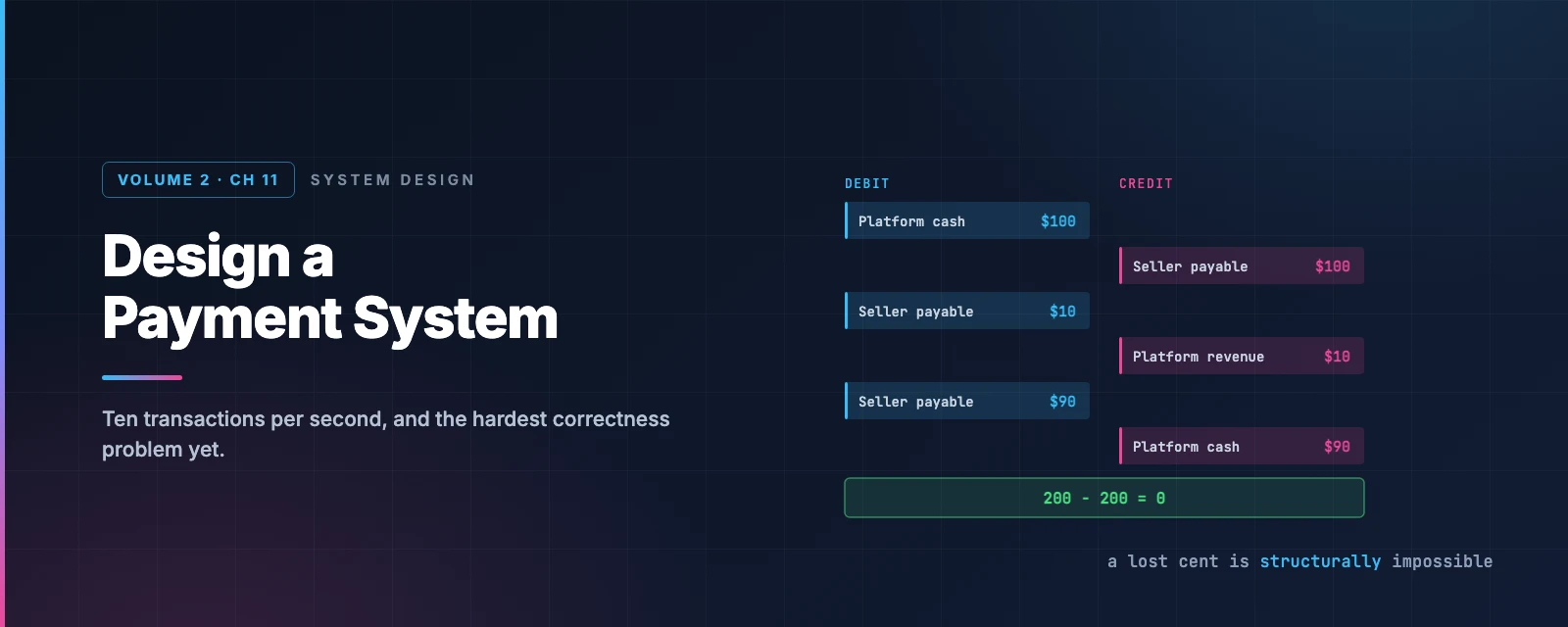
Every transaction is recorded twice: once as a debit, once as a credit, for the same amount.
| Account | Debit | Credit |
|---|---|---|
| Buyer | $1 | |
| Seller | $1 |
Which produces the invariant:
The sum of all entries must be zero.
A cent that leaves one account arrives in another. Money is never created or destroyed by a bug — it can only be misfiled, and a misfiling is visible because the books still balance while an account looks wrong.
This is not an accounting convention that engineers must tolerate. It is an error-detection scheme. A single-entry system that just decrements one balance and increments another can silently lose money if the second write fails. Double-entry makes that impossible to represent: an unbalanced transaction is not a valid transaction.
Build one
Below is a real double-entry ledger. Run a checkout through it and watch the invariant hold:
| Description | Account | Debit | Credit |
|---|
Run pay-in, fee, pay-out in order and you end with platform cash at $10, seller payable at $0, and platform revenue at −$10 — the platform holds $10 of cash which it has earned. Every intermediate state balances.
You cannot break it, and that’s the point. There is no sequence of buttons that produces a non-zero sum, because every action posts two equal entries. The invariant isn’t checked afterwards — it’s structural.
Step 3 — Deep dive
The hosted payment page
Since we don’t touch card numbers, the PSP supplies the form.
sequenceDiagram
    autonumber
    participant C as Client
    participant PS as Payment service
    participant P as PSP

    C->>PS: checkout with order info
    PS->>P: register payment (amount, redirect URL, nonce)
    P-->>PS: token
    Note over PS: persist the token before showing the page
    PS-->>C: render PSP-hosted page with token
    C->>P: card details go straight to the PSP
    P-->>C: redirect to our URL with status
    P->>PS: webhook with final payment status
Two details are load-bearing.
The nonce. A UUID — usually the payment order ID — ensuring the payment is registered exactly once. It becomes the PSP’s idempotency key, so a repeated registration returns the original rather than creating a second charge.
The token is persisted before the page renders. If you show the payment page and then try to save the token, a crash in between leaves a payment the user can complete and you have no record of.
Write down what you’re about to do before you do it. The same instinct as a write-ahead log.
Reconciliation
All nine steps of that flow can fail. There is no retry strategy that covers every case, and asynchronous communication guarantees nothing.
So: every night, the PSP and the banks send a settlement file — the account balance plus every transaction of the day. A reconciliation process parses it and compares against the ledger.
flowchart TD
    SF["Nightly settlement file
from PSP and banks"] --> R["Reconciliation"]
    L[("Our ledger")] --> R
    R --> M{"Match?"}
    M -->|"yes"| OK["Nothing to do"]
    M -->|"classifiable, automatable"| A["Automatic adjustment"]
    M -->|"classifiable, not worth automating"| Q["Finance team queue"]
    M -->|"unclassifiable"| I["Manual investigation"]

    style R fill:#dbeafe,stroke:#2563eb,color:#1e3a8a
    style A fill:#dcfce7,stroke:#16a34a,color:#14532d
    style I fill:#fee2e2,stroke:#dc2626,color:#7f1d1d
Note the three tiers of mismatch, and that two of them end at a human. Not every discrepancy is worth automating; some aren’t understood well enough to automate.
Reconciliation also runs internally — the ledger and the wallet can diverge, and nothing else would notice.
Reconciliation is the last line of defence, and its existence is an admission: in a system spanning multiple companies over unreliable networks, you cannot prevent every inconsistency. You can only guarantee you’ll find it.
Exactly-once, decomposed
The worst thing a payment system can do is charge someone twice. So payments must execute exactly once, which sounds impossible — until you split it:
exactly-once = at-least-once + at-most-once
And each half has a well-understood mechanism.
At-least-once is retry. A payment fails on a flaky network; you retry until it succeeds. Strategies range from immediate retry to exponential backoff — 1s, 2s, 4s — which is the right default when the problem is unlikely to clear quickly. Aggressive retries waste resources and can push a struggling service over.
At-most-once is idempotency. The client generates an idempotency key — a UUID, often the shopping cart ID — and sends it in the HTTP header. The server makes it a primary key:
- Try to insert a row keyed by the idempotency key.
- Insert succeeds → new request, process it.
- Insert fails on the unique constraint → already seen, return the previous result.
The database’s unique constraint does the deduplication. Not application logic that might have a race — a structural guarantee, exactly as in the reservation chapter.
Concurrent requests with the same key: one is processed, the rest get 429 Too Many Requests.
And the same idea protects the second scenario — the PSP charged the card but the response never arrived. The retry sends the same nonce, so the PSP returns the original result rather than charging again. Idempotency has to hold across the boundary, not just inside it.
Failed payments
flowchart LR
    F["Payment fails"] --> Q{"Retryable?"}
    Q -->|"no — invalid input"| DB[("Record the error")]
    Q -->|"yes — transient"| RQ{{"Retry queue"}}
    RQ --> P["Retry payment"]
    P -->|"fails again, under threshold"| RQ
    P -->|"exceeds threshold"| DLQ{{"Dead letter queue"}}
    DLQ --> H["Human investigation"]

    style RQ fill:#fef3c7,stroke:#d97706,color:#78350f
    style DLQ fill:#fee2e2,stroke:#dc2626,color:#7f1d1d
Classify before retrying. A transient network error deserves a retry; an invalid card number will fail identically forever, and retrying it is pure waste.
The dead letter queue is where messages go after repeated failure — isolated for inspection rather than discarded or retried endlessly.
Synchronous or asynchronous?
Synchronous is simpler and degrades badly: one slow service slows everything, a PSP failure breaks the client’s response, and there’s no buffer for a traffic spike.
Asynchronous splits into two shapes:
- Single receiver — a shared queue, message consumed once. Right for “execute this payment”.
- Multiple receivers — Kafka, where the same message is read by several consumers independently. Right for a completed payment that must reach notifications, analytics and billing.
At payment scale with many third-party dependencies, asynchronous wins — trading design simplicity for scalability and failure isolation.
Consistency across five stateful things
Payment service, ledger, wallet, PSP, and database replicas. Any pair can lose contact.
Internally, exactly-once processing is the tool. Externally, idempotency plus reconciliation — and the design says something worth repeating:
Even if an external service supports idempotent APIs, reconciliation is still needed, because we shouldn’t assume the external system is always right.
Replication lag gets two options: serve everything from the primary (simple, wastes replicas), or use consensus — Raft, or a consensus-based database like CockroachDB or YugabyteDB.
What has changed since the book
Authentication became mandatory in Europe
3D Secure appears here as an occasional extra step. In the EU and UK it is required.
PSD2 mandates Strong Customer Authentication for remote electronic card payments: at least two independent factors from something the cardholder knows, has, or is. EMV 3DS2 is the mechanism that satisfies it for card-not-present transactions, and it applies across all 27 EU states plus Iceland, Liechtenstein and Norway.
The interesting part for a designer is the exemptions, because they’re where the friction goes:
- Low value — under €30, with cumulative caps
- Recurring payments — SCA on the first charge, exempt thereafter
- Trusted merchants — customers whitelist you
- Transaction risk analysis — low-risk transactions, judged by the PSP’s fraud engine
That last one is the important one architecturally. The lower your fraud rate, the more transactions you may push through without a challenge — so fraud performance becomes a conversion lever, not just a loss-prevention one. Regulation reshaped the incentive.
The double-entry ledger became a product category
Square’s immutable double-entry accounting service was cited as an example of building one. There are now databases that do nothing else.
TigerBeetle is an OLTP database built exclusively for double-entry accounting. It doesn’t have tables you design — it has accounts and transfers, with the debit/credit schema native. Strict serializability, deterministic execution, no deletes and no history rewriting — which, as its own documentation observes, is exactly what auditors want. It targets on the order of a million transfers per second, which is five orders of magnitude beyond the 10 TPS here.
Why it exists is more interesting than what it does. General-purpose databases spend enormous effort on flexible schemas and arbitrary queries. A ledger needs neither. It needs two entity types, one invariant, and absolute certainty. Narrowing the problem that far buys correctness guarantees and performance a general database cannot match.
The same instinct as the message queue’s append-only log: when the access pattern is narrow enough, a purpose-built store beats a general one on every axis at once.
Network tokens replaced stored card numbers
Not storing card numbers has gone further. Network tokens, issued by the card schemes themselves, replace the card number with a merchant-specific token that updates automatically when the card is reissued.
A card expiring used to break every subscription on it. With network tokens, the token survives and authorisation rates improve measurably. Tokenisation stopped being purely a security measure and became a revenue one.
Idempotency keys have subtleties worth knowing
The design uses a database unique constraint, which is right. Production implementations add two things:
Store the response, not just the key. A constraint violation tells you the request is a duplicate but not what happened the first time. Stripe stores the original response and replays it, so a retry gets the original charge ID rather than an error.
Expire keys. Stripe’s last 24 hours. Keys kept forever become an unbounded table, and a key reused months later almost certainly means a different intent.
What to take away
Throughput is not the problem; correctness under failure is. Ten transactions per second, and this is among the hardest designs in the series. When money is involved, the interesting number is how many ways a request can half-succeed.
Double-entry is an error-detection scheme, not accounting bureaucracy. Sum-to-zero means a lost cent is structurally impossible to represent. Single-entry can silently lose money when the second write fails; double-entry cannot express that state.
exactly-once = at-least-once + at-most-once. Retry gives the first, idempotency the second. Neither is sufficient alone, and the combination has to hold across every boundary — including the PSP’s.
Let the database enforce uniqueness. An idempotency key as a primary key turns deduplication from application logic with a race window into a structural guarantee.
Money is a string until you need to do arithmetic. Floating point cannot represent 0.1, different runtimes round differently, and the range spans satoshis to national GDPs.
Assume you will be inconsistent, and build the thing that finds it. Reconciliation exists because prevention is impossible across companies and unreliable networks. Two of its three mismatch categories end at a human, and that’s the correct design.
“Boring and widely understood” can be a technical requirement. Choosing a database on proven stability, tooling maturity, and whether you can hire a DBA is the right call when the cost of an unusual failure is money someone actually lost.
References and Further Reading
Payments
- Stripe idempotent requests — the reference implementation, including key expiry
- Stripe API reference · PayPal REST APIs
- Strong Customer Authentication — PSD2, SCA and the exemptions
- 3-D Secure · PCI Security Standards Council
- ISO 4217 — currency codes
Ledgers and accounting
- Double-entry bookkeeping — five centuries old and still the answer
- TigerBeetle: debit/credit as the schema for OLTP
- Jepsen analysis of TigerBeetle
Reliability
In this series
- The complete guide — every article in order
- Design a Hotel Reservation System — idempotency keys and unique constraints
- Design a Distributed Message Queue — exactly-once as a transaction boundary
- Ad Click Event Aggregation — reconciliation as the correctness backstop