Design a News Feed System
Every social product has the same question at its centre, and it has exactly two answers:
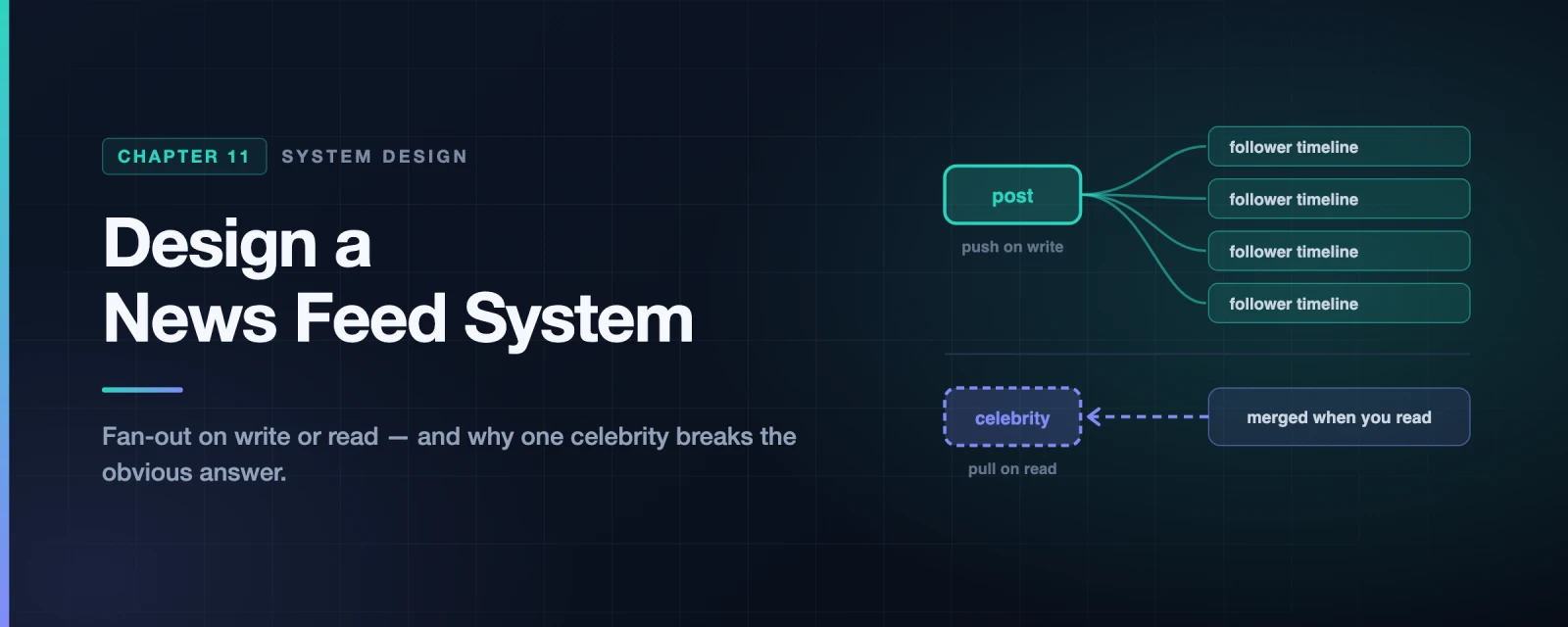
Do you build a user’s feed when someone posts, or when that user opens the app?
That is it. Everything else — the caches, the queues, the graph database — follows from which side you pick. And the reason this is a great interview question is that both answers are wrong, in ways that only become visible when you do the arithmetic.
Pick “when someone posts” and one celebrity with 50 million followers generates 50 million writes for a single post. Pick “when the user opens the app” and every feed load turns into a fan of hundreds of queries while the user stares at a spinner.
The real answer is that you do both, on different accounts, and hide the seam. Let’s build up to why.
Step 1 — Understand the Problem and Establish Scope
Candidate: Mobile app, web, or both?
Interviewer: Both.Candidate: What are the core features?
Interviewer: A user can publish a post, and see their friends’ posts on the feed.Candidate: Is the feed reverse-chronological, or ranked by some score?
Interviewer: Reverse chronological, to keep it simple.Candidate: How many friends can a user have?
Interviewer: Up to 5,000.Candidate: Traffic?
Interviewer: 10 million daily active users.Candidate: Does a post contain media?
Interviewer: Yes — images and video.
Two of those answers deserve a flag, because interviewers plant them deliberately:
- “Reverse chronological” is a simplification, and you should say so. No major feed has worked that way for a decade. Accept it to keep the design tractable, but note that a ranking layer slots in at read time — we come back to where it goes.
- “Up to 5,000 friends” quietly bounds the problem. With a hard ceiling of 5,000, pure fan-out-on-write is survivable. The moment the product allows followers rather than mutual friends, that ceiling disappears and the celebrity problem appears. Asking about this distinction is a strong move.
What the numbers say
| Quantity | Working | Result |
|---|---|---|
| Feed reads | 10M DAU x ~10 refreshes | ~100M reads/day, ~1,200/s |
| Posts | 10M DAU x ~2 posts | ~20M writes/day, ~230/s |
| Read:write ratio | 100M : 20M | ~5:1, read-heavy |
| Fan-out writes | 20M posts x avg friends | billions of timeline writes/day |
The last row is the whole chapter. A modest number of posts becomes an enormous number of writes, because every post is copied into every friend’s feed. This is write amplification, and it is the cost you pay for fast reads.
Step 2 — High-Level Design
Two flows, and it is worth keeping them mentally separate throughout:
- Feed publishing — a user posts; the post reaches their friends’ feeds.
- Feed retrieval — a user opens the app; their feed is assembled and returned.
The APIs
POST /v1/me/feed          publish a post
     params: content, auth_token

GET  /v1/me/feed          retrieve the feed
     params: auth_token, cursor
Note cursor, not page. Offset pagination (?page=2) is broken for feeds: new posts arrive between requests, so page 2 shifts down and the user sees items they already saw, or misses items entirely. Cursor pagination — “give me what comes after post ID X” — is stable under insertion. It is a small detail that signals you have built a feed rather than read about one.
Publishing
flowchart LR
    U["User posts"] --> LB["Load balancer"]
    LB --> WS["Web servers
auth + rate limit"]
    WS --> PS["Post service
persist to DB and cache"]
    WS --> FS["Fanout service
deliver to friends' feeds"]
    WS --> NS["Notification service"]

    style U fill:#2DD4BF,stroke:#0F766E,color:#fff
    style LB fill:#14B8A6,stroke:#0F766E,color:#fff
    style WS fill:#3B82F6,stroke:#1D4ED8,color:#fff
    style PS fill:#8B5CF6,stroke:#6D28D9,color:#fff
    style FS fill:#EC4899,stroke:#BE185D,color:#fff
    style NS fill:#F59E0B,stroke:#B45309,color:#fff
The fan-out service is where all the difficulty lives. Everything else is routine.
Step 3 — The Central Trade-off
Fan-out on write (push)
When a user posts, immediately write that post’s ID into every friend’s cached timeline. The feed is pre-computed — reading it is a single cache lookup.
flowchart TD
    P["Alice posts"] --> F["Fanout worker
reads Alice's friend list"]
    F --> T1["Bob's timeline
+ post ID"]
    F --> T2["Carol's timeline
+ post ID"]
    F --> T3["...5,000 more writes"]
    T1 --> R["Bob opens the app:
one cache read, done"]

    style P fill:#2DD4BF,stroke:#0F766E,color:#fff
    style F fill:#EC4899,stroke:#BE185D,color:#fff
    style T1 fill:#3B82F6,stroke:#1D4ED8,color:#fff
    style T2 fill:#3B82F6,stroke:#1D4ED8,color:#fff
    style T3 fill:#EF4444,stroke:#B91C1C,color:#fff
    style R fill:#10B981,stroke:#047857,color:#fff
Good: reads are as fast as they can possibly be — one lookup of a pre-built list. Posts appear in real time.
Bad: writes are amplified by the friend count. And you do this work for every friend, including the ones who have not opened the app in eight months. At 10M DAU, a large fraction of fan-out work is delivering posts to feeds nobody will ever load.
Fan-out on read (pull)
Write nothing at post time. When a user opens the app, fetch their friend list, query recent posts from each, merge, sort, return.
flowchart TD
    R["Bob opens the app"] --> FL["Fetch Bob's friend list"]
    FL --> Q["Query recent posts
from each of 5,000 friends"]
    Q --> M["Merge and sort by time"]
    M --> OUT["Return the feed"]
    P["Alice posts"] --> DB["Write once. That is all."]

    style R fill:#818CF8,stroke:#4338CA,color:#fff
    style FL fill:#818CF8,stroke:#4338CA,color:#fff
    style Q fill:#EF4444,stroke:#B91C1C,color:#fff
    style M fill:#F59E0B,stroke:#B45309,color:#fff
    style OUT fill:#10B981,stroke:#047857,color:#fff
    style P fill:#2DD4BF,stroke:#0F766E,color:#fff
    style DB fill:#10B981,stroke:#047857,color:#fff
Good: writing a post is one write. Dormant users cost nothing. No hot-key problem.
Bad: every feed load becomes hundreds or thousands of queries plus a merge — and this happens on the read path, which is the path with a user waiting on it, and which we established is 5x more frequent than writes.
Side by side
| Fan-out on write (push) | Fan-out on read (pull) | |
|---|---|---|
| Work at post time | High — one write per follower | One write |
| Work at read time | One cache read | High — fan-in and merge |
| Feed latency | Excellent | Poor |
| Wasted effort | Fanning out to dormant users | None |
| Breaks when | An account has millions of followers | Everyone has many friends |
| Best suited to | Ordinary accounts | Celebrity accounts |
The last row gives away the answer.
The Celebrity Problem
This is the part to be able to derive on the spot, because the arithmetic makes the argument for you.
An account with 50 million followers posts once. Under fan-out on write:
1 post x 50,000,000 followers = 50,000,000 timeline writes
For one post. Post ten times a day and that single account generates 500 million writes daily. Now consider that a platform has thousands of such accounts.
flowchart TD
    C["Celebrity posts once"] --> FO{"Fan-out on write?"}
    FO -->|Yes| BOOM["50,000,000 cache writes
for a single post"]
    BOOM --> B1["Fanout workers saturated
for minutes"]
    BOOM --> B2["Ordinary users' posts stuck
behind the celebrity in the queue"]
    BOOM --> B3["Followers at the end of the list
see the post minutes late"]
    FO -->|"No — skip fan-out"| SKIP["Write once to the celebrity's
own post store"]
    SKIP --> PULL["Followers pull it
when they open the app"]

    style C fill:#EC4899,stroke:#BE185D,color:#fff
    style FO fill:#F59E0B,stroke:#B45309,color:#fff
    style BOOM fill:#EF4444,stroke:#B91C1C,color:#fff
    style B1 fill:#EF4444,stroke:#B91C1C,color:#fff
    style B2 fill:#EF4444,stroke:#B91C1C,color:#fff
    style B3 fill:#EF4444,stroke:#B91C1C,color:#fff
    style SKIP fill:#10B981,stroke:#047857,color:#fff
    style PULL fill:#10B981,stroke:#047857,color:#fff
The damage is not confined to the celebrity. Because fan-out workers are shared, one celebrity post delays every ordinary user’s post sitting behind it in the queue. A single account degrades the product for everyone — the same head-of-line blocking we saw with notification queues in Chapter 10, wearing a different hat.
The hybrid
Split accounts by follower count and treat them differently:
flowchart TD
    POST["A post is published"] --> CHK{"Follower count
above the threshold?"}
    CHK -->|"No — ordinary account"| PUSH["Fan out on write
into each follower's timeline"]
    CHK -->|"Yes — celebrity"| STORE["Skip fan-out.
Store on the author's own timeline"]
    PUSH --> CACHE[("Pre-computed timelines")]
    STORE --> CELEB[("Celebrity post store")]
    READ["User opens the app"] --> MERGE["Read pre-computed timeline
+ pull posts from the few
celebrities they follow"]
    CACHE --> MERGE
    CELEB --> MERGE
    MERGE --> SORT["Merge, sort, return"]

    style POST fill:#2DD4BF,stroke:#0F766E,color:#fff
    style CHK fill:#F59E0B,stroke:#B45309,color:#fff
    style PUSH fill:#3B82F6,stroke:#1D4ED8,color:#fff
    style STORE fill:#818CF8,stroke:#4338CA,color:#fff
    style CACHE fill:#8B5CF6,stroke:#6D28D9,color:#fff
    style CELEB fill:#8B5CF6,stroke:#6D28D9,color:#fff
    style READ fill:#2DD4BF,stroke:#0F766E,color:#fff
    style MERGE fill:#EC4899,stroke:#BE185D,color:#fff
    style SORT fill:#10B981,stroke:#047857,color:#fff
Why this works is a distribution argument, and it is worth stating explicitly:
- Almost every account is ordinary. The overwhelming majority of posts take the cheap push path.
- Almost every user follows only a handful of celebrities. So the read-time merge pulls from perhaps five or ten sources, not five thousand. The expensive path stays small because celebrities are rare.
The threshold is a tuning knob, commonly somewhere around 10,000 followers. It is not a constant of nature — it is where, on your infrastructure, the cost of fanning out exceeds the cost of merging at read time.
Two refinements that show operational thinking:
- Do not fan out to dormant accounts. If a user has not opened the app in 30 days, skip their timeline and rebuild it on demand when they return. On a mature platform this removes a large share of all fan-out work.
- The threshold should be dynamic. An account that crosses it mid-crisis should switch modes automatically, not wait for someone to notice.
Step 4 — Design Deep Dive
Inside the fan-out service
flowchart TD
    NEW["New post"] --> G["Graph DB
fetch follower IDs"]
    G --> FILT["Filter: muted, blocked,
restricted audience, dormant"]
    FILT --> MQ["Message queue"]
    MQ --> W["Fanout workers"]
    W --> NF[("Feed cache
post_id per user_id")]

    style NEW fill:#2DD4BF,stroke:#0F766E,color:#fff
    style G fill:#8B5CF6,stroke:#6D28D9,color:#fff
    style FILT fill:#F59E0B,stroke:#B45309,color:#fff
    style MQ fill:#38BDF8,stroke:#0284C7,color:#fff
    style W fill:#10B981,stroke:#047857,color:#fff
    style NF fill:#EC4899,stroke:#BE185D,color:#fff
Three details that matter:
- A graph database holds the social graph. Friend-of-friend traversals are painful in SQL and natural in a graph store.
- Filtering happens before the queue, not after. Muted users, blocked users and restricted-audience posts are removed up front, so you never pay to write a post into a timeline that must not show it.
- Store IDs only, and cap the list. The feed cache holds post IDs, not post bodies — storing full objects would multiply memory by the number of followers. Cap each timeline at a few hundred entries: nobody scrolls to post 3,000, and the cap makes memory predictable. In Redis this is
LPUSHfollowed byLTRIM.
Retrieval and hydration
flowchart TD
    REQ["GET /v1/me/feed"] --> IDS["Feed cache:
list of post IDs"]
    IDS --> HYD["Hydration:
fetch the actual objects"]
    HYD --> PC[("Post cache
content")]
    HYD --> UC[("User cache
names, avatars")]
    HYD --> AC[("Action cache
liked? commented?")]
    HYD --> CT[("Counter cache
like and reply counts")]
    PC --> JSON["Assemble JSON"]
    UC --> JSON
    AC --> JSON
    CT --> JSON
    JSON --> CDN["Media served from CDN"]

    style REQ fill:#2DD4BF,stroke:#0F766E,color:#fff
    style IDS fill:#EC4899,stroke:#BE185D,color:#fff
    style HYD fill:#3B82F6,stroke:#1D4ED8,color:#fff
    style PC fill:#8B5CF6,stroke:#6D28D9,color:#fff
    style UC fill:#8B5CF6,stroke:#6D28D9,color:#fff
    style AC fill:#8B5CF6,stroke:#6D28D9,color:#fff
    style CT fill:#8B5CF6,stroke:#6D28D9,color:#fff
    style JSON fill:#10B981,stroke:#047857,color:#fff
    style CDN fill:#F59E0B,stroke:#B45309,color:#fff
Hydration is the step people forget. The timeline is a list of IDs; the screen needs author names, avatars, text, counts, and whether you liked each post. That is several cache lookups per post, batched — and it is why the cache tier is layered rather than monolithic:
| Layer | Holds | Why separate |
|---|---|---|
| Feed | Post IDs per user | Small, hot, written by fan-out |
| Content | Post bodies | Large; popular posts in a hot subset |
| Social graph | Follower and following lists | Read on every fan-out |
| Action | Did this user like this post | Per user-post pair, huge cardinality |
| Counter | Like and reply totals | Write-heavy, updated constantly |
They are separated because their access patterns and update rates differ by orders of magnitude. Counters change constantly; post bodies almost never do. Sharing one cache would force the worst policy on all of them.
Media never passes through your servers. Images and video go to a CDN, and the feed JSON carries URLs. Serving a video through your application tier is a classic and expensive mistake.
Beyond the Book
Real feeds are ranked, not chronological
The interviewer’s “reverse chronological” simplification has not matched a production feed since roughly 2015. Real feeds score every candidate post and sort by predicted engagement.
That changes where the work goes: fan-out still assembles the candidate set, but a ranking service scores it at read time before returning. The architecture above survives — you insert a scoring step between hydration and response — but two things shift:
- The timeline cap must be generous. Ranking needs candidates to choose among, so you keep more than the 20 you will display.
- Ranking is on the read path, so it has a latency budget. This is where feed systems actually spend their milliseconds today.
Say this out loud even when the interviewer specified chronological. It shows you know the simplification is a simplification.
Edits, deletes, and the cost of denormalisation
Fan-out on write is denormalisation: one post now exists in millions of timelines. So what happens when it is deleted?
You do not chase it through millions of timelines. Because the timeline stores only IDs, you delete the post from the content store, and hydration simply finds nothing and skips it. This is the quiet payoff of storing IDs rather than bodies — it turns a distributed deletion problem into a no-op.
The same logic covers edits, blocks applied after the fact, and privacy changes: resolve at hydration, not at fan-out.
What to monitor
- Fan-out lag — time from publish to the post landing in the last follower’s timeline. This is the number that degrades first under load.
- Feed load p99, not the mean. Means hide the users with 5,000 friends and twelve celebrity follows.
- Cache hit rate per layer. A drop in the counter cache and a drop in the feed cache mean completely different things.
Interview Quick Reference
The core question: build the feed at write time or read time?
| Push (write) | Pull (read) | Hybrid | |
|---|---|---|---|
| Post cost | High | Low | Low for celebrities, high for the rest |
| Read cost | Low | High | Low, plus a small merge |
| Celebrity safe | No | Yes | Yes |
| Used in production | Rarely alone | Rarely alone | Yes |
The celebrity arithmetic: 1 post x 50M followers = 50M writes. Ten posts a day = 500M writes for one account — and the shared fan-out workers delay everyone else’s posts too.
The hybrid, in one line: push for ordinary accounts, skip fan-out for celebrities, merge both at read time. It works because celebrities are rare, so the expensive path stays small.
Details that mark out a strong answer:
- Cursor pagination, not offsets — feeds shift under you between requests.
- Store post IDs, not post bodies, and cap timeline length.
- Filter before the queue — never fan out a post that must not be shown.
- Skip dormant users and rebuild their feed on return.
- Hydration is a real step, and it drives the five-layer cache split.
- Deletion is free because timelines hold IDs — resolve at hydration.
- Real feeds rank at read time; chronological is the interviewer’s simplification.
Summary
| Idea | Why it matters |
|---|---|
| Two choices only | Precompute at write, or assemble at read |
| Write amplification | 20M posts becomes billions of timeline writes |
| Neither pure model works | Push breaks on celebrities, pull breaks on latency |
| The hybrid works on distribution | Celebrities are rare, so the costly path stays small |
| Store IDs, not objects | Bounds memory and makes deletion trivial |
| Hydration is the hidden cost | A timeline of IDs is not a screen |
| Resolve at read, not at write | Edits, deletes and privacy stay correct without rewriting history |
References and Further Reading
The primary sources
- How News Feed Works — Facebook’s own explanation of what a feed is meant to do
- The Infrastructure Behind Twitter: Scale — the timeline architecture, from the team that built it
- Facebook’s TAO: The Power of the Graph — the graph store behind the social graph
Fan-out in depth
- Twitter’s fan-out strategy at scale — the hybrid and the threshold, with numbers
- Fan-out on write vs fan-out on read — the trade-off laid out plainly
- Redis lists —
LPUSHandLTRIM, the two commands a timeline cache is built from
Related chapters
- Chapter 10: Design a Notification System — the same head-of-line blocking problem, in a different guise
- Chapter 1: Scale From Zero to Millions of Users — the caching and CDN tiers this design assumes
- Chapter 5: Design Consistent Hashing — distributing the hot keys fan-out creates
Books
- System Design Interview – An Insider’s Guide — Alex Xu. The chapter this article follows.
- Designing Data-Intensive Applications — Martin Kleppmann. Chapter 1 works through this exact Twitter fan-out example as its opening case study, and is the best treatment in print.
What’s Next?
In Chapter 12 we design a chat system — where the constraint inverts. A feed can be seconds stale and nobody minds; a chat message that arrives late, twice, or out of order is a visible bug. That pushes the design towards long-lived connections, per-conversation ordering, and delivery state that both participants can see.
The move in this chapter generalises. When one workload is cheap for almost everyone and ruinous for a rare few, do not design for the average — classify, and run two strategies. The threshold between them is a tuning knob, not an architecture.