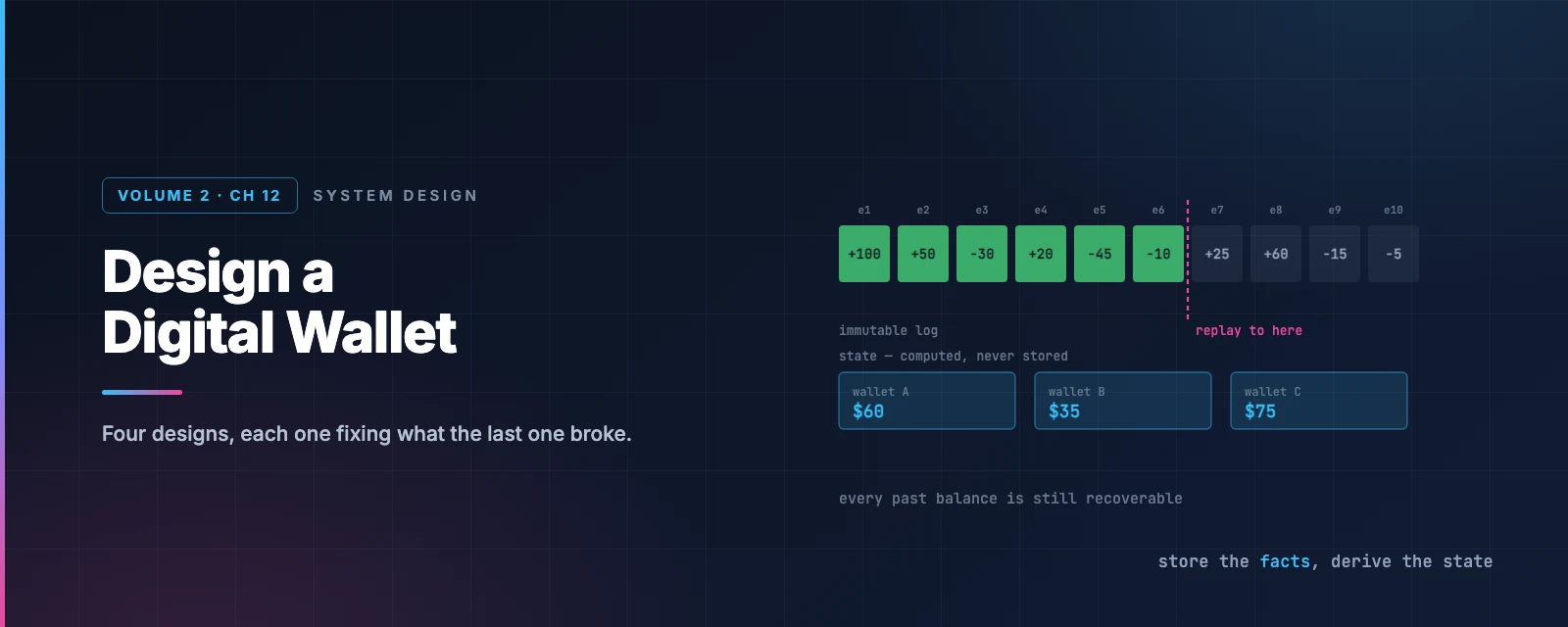
Design a Digital Wallet
Move $1 from wallet A to wallet B. A million times a second.
That’s the whole problem, and it is the best-structured chapter in this series — because rather than presenting one architecture, it walks through four, each one solving what the previous one broke:
- In-memory sharding — fast, and loses money when a node crashes
- Distributed transactions — correct, and you can’t explain why a balance is what it is
- Event sourcing — auditable, and too slow going over the network
- Distributed event sourcing — fast, reliable, and shardable
Watching a design fail four times is more instructive than seeing the final answer, so that’s how this is written.
Step 1 — Scope
- Balance transfers between two wallets — nothing else
- 1,000,000 TPS
- 99.99% reliability
- Transactional guarantees
- Reproducibility
That last requirement is unusual and it drives everything after design two:
Reconciliation only shows that there is a discrepancy, never how it arose. We want a system where historical balances can be reconstructed by replaying data from the very beginning.
The arithmetic that sets the goal
Assume a database node handles 1,000 TPS. A million transfers a second therefore needs 1,000 nodes — except each transfer is two operations, a debit and a credit. So 2 million operations, and 2,000 nodes.
| Per-node TPS | Nodes needed |
|---|---|
| 100 | 20,000 |
| 1,000 | 2,000 |
| 10,000 | 200 |
Node count is inversely proportional to per-node throughput, and hardware cost follows. So a design goal falls out of the estimate: make each node do more. That’s what motivates the file-based optimisations later.
The API
One endpoint. That is not a simplification for the sake of the chapter — it is what makes the rest of it hard.
POST /v1/wallet/balance_transfer
| Parameter | Notes |
|---|---|
from_account, to_account | The two sides of the transfer |
amount | A string, not a float |
currency | ISO code |
transaction_id | Client-supplied, for idempotency |
{
  "status": "success",
  "transaction_id": "01589980-2664-11ec-9621-0242ac130002"
}
Two of those fields carry the whole design.
amount is a string. Binary floating point cannot represent 0.10 exactly, and a rounding error in a wallet is a rounding error in someone’s money. Send the decimal as text and parse it into a fixed-point or arbitrary-precision type at the boundary. Every payments system does this, and the ones that didn’t have a story about why they do now.
transaction_id comes from the client, exactly as the reservation ID does in the hotel chapter. A retry after a timeout carries the same ID, so the second attempt is recognised rather than executed. Without it, “did my transfer go through?” has no safe answer — and every design below is built on being able to replay commands.
Design 1 — In-memory sharding
Balances are a map from account to amount. Redis, sharded across nodes by hash(accountID) % n, with ZooKeeper holding the shard map. A stateless wallet service applies transfers.
flowchart TD
    C["Transfer command
A → $1 → B"] --> WS["Wallet service
stateless"]
    ZK["ZooKeeper
shard map"] -.-> WS
    WS -->|"A: −$1"| R1[("Redis 1")]
    WS -->|"B: +$1"| R2[("Redis 2")]

    style WS fill:#dbeafe,stroke:#2563eb,color:#1e3a8a
    style R1 fill:#fee2e2,stroke:#dc2626,color:#7f1d1d
    style R2 fill:#fee2e2,stroke:#dc2626,color:#7f1d1d
Fast, horizontally scalable, and wrong.
Two Redis nodes, two updates, no atomicity. If the wallet service crashes between them, $1 has been deducted and never arrives. Money vanishes.
A transfer is one logical operation and two physical writes. Everything that follows is about closing that gap.
Design 2 — Distributed transactions
Replace Redis with transactional relational databases. That makes each local update atomic and does nothing about the pair. Three ways to fix it.
Two-phase commit
A coordinator asks every database to prepare; if all say yes it tells them to commit, otherwise abort.
sequenceDiagram
    participant C as Coordinator
    participant A as Database A
    participant B as Database B
    Note over A,B: both locked
    C->>A: prepare
    C->>B: prepare
    A-->>C: yes
    B-->>C: yes
    C->>A: commit
    C->>B: commit
It works, and it has two well-known problems. Locks are held across network round trips, which destroys throughput at a million TPS. And the coordinator is a single point of failure — if it dies after “prepare”, every participant sits locked, waiting.
It’s also a low-level solution requiring database support for the prepare step, via standards like X/Open XA.
Try-Confirm/Cancel
TC/C looks similar and differs in one decisive way: each phase is its own transaction, committed immediately.
| Phase | Account A | Account C |
|---|---|---|
| Try | −$1 | nothing |
| Confirm | nothing | +$1 |
| Cancel | +$1 | nothing |
Nothing stays locked between phases. Failure is handled not by aborting but by running a compensating transaction — adding the dollar back.
Which produces something genuinely startling:
At the end of the Try phase, $1 does not exist. A is down a dollar; C hasn’t received it. The books do not balance.
In 2PC that intermediate state is hidden inside the database. In TC/C it’s visible to the application, because the application is the one orchestrating it. The inconsistency was always there — TC/C just stops pretending otherwise, and makes you responsible for resolving it.
Two consequences worth their own paragraphs.
Order matters, and only one order is valid. Deduct first, then credit. Credit-first means someone could withdraw money that was never funded. Doing both concurrently means either can fail with the other already done.
Out-of-order execution is possible. A slow network can deliver a Cancel before the Try it cancels. So a node must be able to Cancel something it hasn’t seen: it records an out-of-order flag, and a later Try checks that flag and fails. Which is why the phase status table needs one.
And because the coordinator can restart mid-transaction, its progress must be persisted — that’s the phase status table, stored with the account being debited.
Saga
Saga runs operations in a linear sequence, each a local transaction. On failure it rolls back in reverse order using compensating transactions. For n operations you write 2n: the forward path and the undo path.
flowchart LR
    S["Start"] --> A["A: −$1"] --> C["C: +$1"] --> OK["Success"]
    A -.->|"error"| RA["A: +$1 (compensate)"]
    C -.->|"error"| RC["C: −$1 (compensate)"] -.-> RA

    style OK fill:#dcfce7,stroke:#16a34a,color:#14532d
    style RA fill:#fee2e2,stroke:#dc2626,color:#7f1d1d
    style RC fill:#fee2e2,stroke:#dc2626,color:#7f1d1d
Coordination comes in two flavours: choreography, where services react to each other’s events with no central authority, and orchestration, where one coordinator sequences everything. Choreography is fully decentralised and becomes very hard to reason about — each service needs its own state machine to interpret everyone else’s events. Orchestration is the usual choice here.
Choosing between them
| 2PC | TC/C | Saga | |
|---|---|---|---|
| Level | Database | Application | Application |
| Locks held across phases | ✓ | ✗ | ✗ |
| Execution order | Any | Any | Linear |
| Parallel execution | ✓ | ✓ | ✗ |
| Partial state visible | ✗ | ✓ | ✓ |
TC/C can run operations in parallel; Saga cannot. So: few services or no latency pressure → Saga, and you’re aligned with microservice convention. Many services and latency-sensitive → TC/C.
And it still isn’t enough
The balance is correct. But it’s a number in a row, overwritten on every transfer.
An auditor asks: what was this balance last Tuesday? Why did it change? Prove the logic was correct before the deploy.
The design cannot answer any of them, because updating a row destroys the history that would.
Design 3 — Event sourcing
Stop storing balances. Store the facts that produced them.
Four terms:
- Command — an intent. “Transfer $1 from A to C.” May be invalid. May involve randomness or I/O.
- Event — a validated fact. “Transferred $1 from A to C.” Past tense, immutable, deterministic.
- State — balances, derived by applying events.
- State machine — validates commands into events, and applies events to state. Must contain no randomness, or replay wouldn’t reproduce.
flowchart LR
    CQ{{"Command queue
intents, may fail"}} --> SM1["State machine
validate"]
    SM1 --> EQ{{"Event queue
facts, immutable"}}
    EQ --> SM2["State machine
apply"]
    SM2 --> ST[("State
derived, disposable")]

    style CQ fill:#fef3c7,stroke:#d97706,color:#78350f
    style EQ fill:#dcfce7,stroke:#16a34a,color:#14532d
    style ST fill:#dbeafe,stroke:#2563eb,color:#1e3a8a
The database stops being the source of truth and becomes a cached view. The event log is the truth. State is a convenience — derivable, and therefore disposable.
Replay it yourself
Below is an event log and the balances derived from it. Scrub through and watch state being computed rather than stored:
Nothing here is stored. Every balance is recomputed from the log above.
Drag it back and forth. Every historical balance is available, because nothing was overwritten — the state at event 6 is simply the first six events applied.
That answers all three auditor questions. What was the balance on Tuesday? Replay to Tuesday. Is it correct? Recompute it from the log. Was the logic right before the deploy? Run both versions of the code over the same events and compare.
Reproducibility is not a feature bolted on. It is what you get for free when you stop destroying history.
CQRS
The wallet still has to tell users their balance, and the event log isn’t a useful thing to query.
Command Query Responsibility Segregation: one state machine handles writes; many read-only state machines subscribe to the same event stream and build whatever view they need. Balances for the UI. A period-specific view for investigating a double charge. An audit trail for reconciliation.
Read models lag slightly and always catch up — eventually consistent by construction.
Publishing events rather than state lets every consumer derive the shape they need. Publish state and you’ve decided for them.
Design 4 — Making it fast, reliable and shardable
Event sourcing over Kafka and a remote database means every command crosses the network several times. At a million TPS that’s the bottleneck.
Put everything on local disk
Commands and events go to local files. The event list is append-only, so writes are sequential — and sequential disk access can outperform random memory access. The same argument as the message queue chapter, reached independently.
mmap maps the file into memory, so the OS caches recent content automatically. For append-only access, essentially everything hot is in memory.
State goes local too — SQLite, or RocksDB, whose LSM tree is write-optimised.
Snapshots
Replaying from the beginning gets slower forever. So periodically freeze the state to a snapshot — an immutable view at a point in time. Replay resumes from the last snapshot instead of from zero.
Finance teams typically want one at 00:00 so the day’s transactions can be verified in isolation.
Which data actually needs to be durable?
This is the most elegant reasoning in the chapter, and it’s worth following carefully. There are four kinds of data:
State and snapshots are derived from events. Lose them, replay, get them back. No durability needed.
Commands look like the root — events come from commands, so surely commands are what matter? No. Command→event generation may involve randomness or external I/O, so replaying commands is not guaranteed to reproduce the same events.
Events are deterministic, immutable historical facts, and everything else derives from them.
Only the event log requires a strong durability guarantee. Everything else is recomputable.
That’s a remarkably small surface to protect — and it’s only small because of a property established pages earlier, that events must be deterministic. The constraint bought the simplification.
Consensus
So replicate the event log with Raft. One leader accepts commands and converts them to events; followers receive replicated events. With 5 nodes the system tolerates 2 failures; with 3, one.
flowchart TD
    C["Command"] --> L["Leader
validates, generates events"]
    L -->|"replicate"| F1["Follower"]
    L -->|"replicate"| F2["Follower"]
    L --> S1[("State")]
    F1 --> S2[("State")]
    F2 --> S3[("State")]

    style L fill:#dbeafe,stroke:#2563eb,color:#1e3a8a
    style S1 fill:#dcfce7,stroke:#16a34a,color:#14532d
    style S2 fill:#dcfce7,stroke:#16a34a,color:#14532d
    style S3 fill:#dcfce7,stroke:#16a34a,color:#14532d
Every node — leader and followers — applies the event list and updates its own state. Raft guarantees identical event lists; determinism guarantees identical states. The two properties compose exactly.
If the leader dies mid-conversion, the client times out and resends to the new leader.
Then shard
One Raft group has a capacity ceiling. Above it, partition accounts across groups — and now transfers can span groups, so you need distributed transactions again: TC/C or Saga over event-sourced Raft groups.
Also, CQRS’s read path is asynchronous, so clients would have to poll for their result. A reverse proxy in front, with read-only state machines pushing status back as events arrive, restores a synchronous-feeling response.
What has changed since the book
The throughput estimate is very conservative
The whole node-count table rests on “assume a database node handles 1,000 TPS”. That was cautious when written and is more so now — a well-tuned modern relational node on NVMe storage handles far more write throughput than that, and purpose-built stores like TigerBeetle target a million transfers a second on modest hardware.
The reasoning stands entirely — node count is inversely proportional to per-node throughput, and doubling per-node throughput halves your fleet. Only the constant has moved, and it has moved by an order of magnitude or more. Rerun the arithmetic before quoting the fleet size.
2PC lost; Saga won
Presented as three live options, this is now largely settled. Two-phase commit is rare in new systems — coordinator blocking and cross-network locking are disqualifying at scale, and XA support is patchy.
Saga became the microservices default, with orchestration preferred over choreography for exactly the reason given here: choreography’s implicit state machines are unmaintainable past a handful of services.
TC/C remains a real option and is far less widely known, which makes it a genuinely useful thing to have in an interview — it gives you parallelism that Saga’s linear ordering forbids.
The outbox pattern is the missing piece
There’s a gap the chapter doesn’t address: how does an event get into the log and published to consumers atomically? Writing to your database and then to Kafka is a dual write, and the two can disagree — the database commits and the publish fails, or vice versa.
The transactional outbox solves it: write the event to an outbox table in the same transaction as the state change. They commit together, so they cannot disagree. A separate process — usually change data capture tailing the write-ahead log — forwards to the broker.
Same instinct as everything else here: when two things must agree, put them in one transaction rather than sequencing them carefully.
Event sourcing is powerful and frequently overused
Worth saying plainly, because the chapter presents it as an unambiguous win.
Event sourcing costs real complexity. Schema evolution is genuinely hard — events are immutable, so a five-year-old event must still be interpretable by today’s code, forever. Replay time grows without snapshot discipline. Eventual consistency in read models surprises people. And “just query the current state” becomes a design exercise.
It earns that cost when the history is the product — audit, regulation, financial reconciliation, “prove this number”. A digital wallet is exactly that case, which is why it’s the right answer here.
For a system where nobody will ever ask what a value was last Tuesday, a plain table and an audit log is usually the better engineering.
What to take away
Four designs, each fixing the last. In-memory sharding loses money on crash. Distributed transactions fix atomicity and destroy history. Event sourcing restores history and is too slow remotely. Local files plus Raft fix that. Each design is correct about the problem it was built for and wrong about the next one.
A transfer is one logical operation and two physical writes. Every technique here — 2PC, TC/C, Saga, event sourcing — is a different way of closing that gap.
TC/C makes the inconsistency visible rather than creating it. At the end of the Try phase a dollar genuinely does not exist. 2PC hides that inside the database; TC/C hands it to you, along with responsibility for it.
Store facts, derive state. Overwriting a balance destroys the only record of why it changed. Keeping events makes every historical state recoverable, and every auditor’s question answerable by replay.
Determinism is what makes replication cheap. Because events are deterministic, Raft only has to agree on the log — identical logs give identical states for free. And because state is derivable, only the log needs durability.
Publish events, not state. Consumers derive the view they need. Publishing state decides for them, and you’ll be wrong for someone.
References and Further Reading
Distributed transactions
- Two-phase commit · X/Open XA
- The Saga pattern · Compensating transactions
- The transactional outbox pattern · Debezium
Event sourcing and CQRS
- Event sourcing — Martin Fowler
- CQRS — Martin Fowler, including when not to use it
- Domain-driven design — where both originate
- Designing Data-Intensive Applications — Chapter 11 on event streams and derived state
Storage and consensus
- Raft — the consensus algorithm replicating the event log
- RocksDB · SQLite · mmap
- Apache Kafka · ZooKeeper
In this series
- The complete guide — every article in order
- Design a Payment System — the ledger this wallet sits beside
- Design a Distributed Message Queue — append-only logs and sequential writes
- Design a Hotel Reservation System — why one database beat Saga there